
1999
Early neuromorphic vision in flight
Centeye’s founder flew early neuromorphic vision sensing on a small aerial vehicle before Centeye was formed.
Company
Centeye is a Washington, DC-based advanced-vision technology company developing custom vision silicon, miniature sensor assemblies, embedded vision systems, and supporting processing for demanding commercial and government applications.
Centeye works with OEMs, system integrators, primes, research organizations, and government teams to develop, adapt, integrate, and transition specialized sensing technology.
Current Direction
Centeye is a technology supplier and development partner focused on application-specific sensing from component development through system integration.
Centeye’s role is often to provide the sensing and embedded interpretation layer within a customer’s larger product or platform.
Explore capabilities →Engineering Approach
Centeye works across multiple layers of the sensing stack and is willing to change the sensing architecture itself when a one-size-fits-all camera and processing pipeline is poorly matched to the task. Constraints at one layer can therefore be addressed elsewhere in the sensing stack.
Technical Depth
Supporting experience includes nine Phase II SBIR/STTR programs and other customer-funded and sponsored development. This supports the technical record without defining Centeye solely as a sponsored-research organization.
Selected organizations Centeye has worked with
AeroVironment · Aurora Flight Sciences · Avanade · Boeing · Infusion · Lockheed Martin · Nautilus Defense · Pfizer · Raytheon
Harvard University · MIT · UC Berkeley · University of Colorado Boulder · University of Maryland · University of Michigan · UMass Amherst
DARPA · U.S. Air Force · IARPA · DTRA · U.S. Navy · U.S. Army · National Science Foundation
Technical Continuity
Centeye’s current technology builds on successive generations of neuromorphic sensing, embedded machine vision, and severely constrained robotic systems.
1999
Centeye’s founder flew early neuromorphic vision sensing on a small aerial vehicle before Centeye was formed.
2000
Centeye was founded and began its continuous development of advanced vision technology.
2000
Centeye founder Geoffrey Barrows demonstrated outdoor altitude hold on a small aerial vehicle using optical-flow sensing.
Historical footage of the 2000 outdoor altitude-hold demonstration.
2002
Downward-looking optical-flow sensing was used to demonstrate altitude hold over snow on a cloudy day.
Historical footage of the 2002 altitude-hold demonstration over snow.
2003
A first onboard obstacle-avoidance demonstration was performed on a small aerial vehicle. A second demonstration later that year is documented below.
2010
Micro-helicopter hover was demonstrated using a lightweight multi-sensor vision architecture.
2012
A complete optical-flow sensor assembly developed for RoboBees weighed 128 milligrams, excluding its cable.
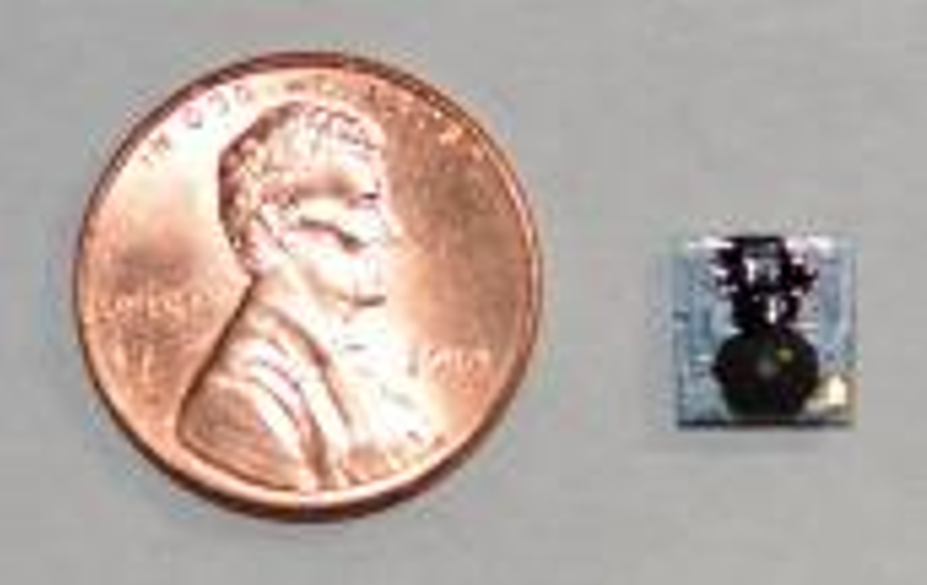
The complete sensor board and its components shown beside a penny for scale.
2013
A multiple-aperture wide-field-of-view sensor supported optical flow at 300 Hz.
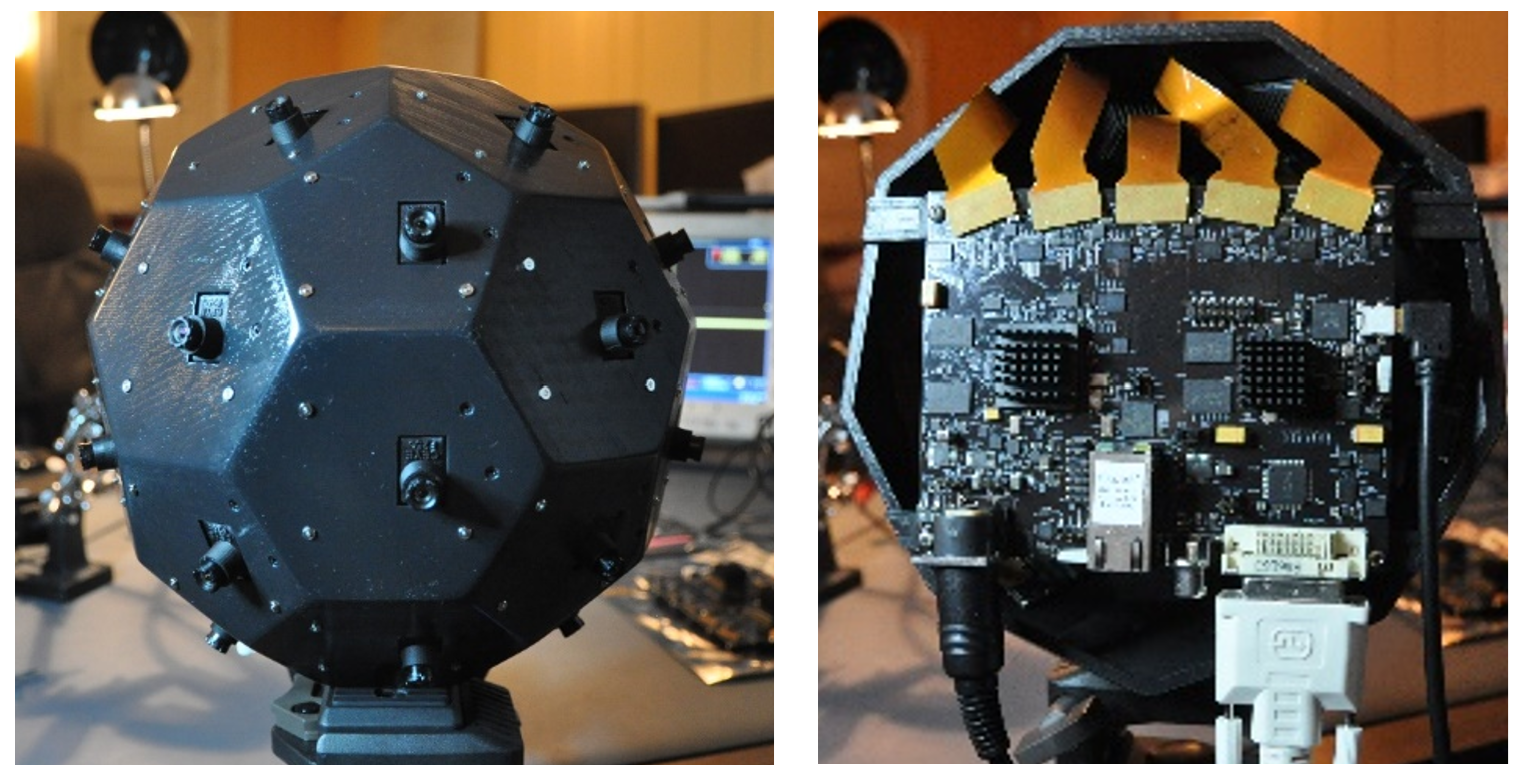
External and internal views of the multi-aperture sensor assembly.
2010s
Centeye continued developing custom vision silicon, miniature vision sensors, optical-flow sensing, stereo perception, and highly constrained onboard machine vision.
2015–2017
Historical nano-UAS demonstrations showed fully onboard vision-based perception and reactive obstacle avoidance under severe size, weight, and power constraints.
2016
A compact sensor assembly combined stereo vision, optical flow, and proximity sensing.
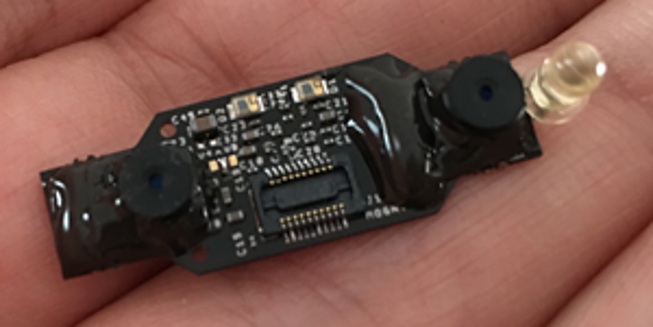
The integrated 2016 sensor assembly shown in hand for scale.
2020s
Work expanded across custom focal-plane architectures, miniature embedded vision systems, adaptive and flexible-acuity sensing, high-dynamic-range vision, tracking, wearable and embedded sensing, and customer-oriented technology integration.
Selected Historical Demonstrations
These released demonstrations document earlier sensing and onboard-processing work on historical test platforms, not current products.
Historical footage from 2003 showing onboard obstacle avoidance on a small aerial test platform.
Accumulated Depth
Centeye’s value is not simply that it has worked in vision for a long time. The company has accumulated reusable silicon architectures, sensor designs, processing methods, integration experience, and first-principles engineering knowledge across multiple generations of technology.
Working With Centeye
Incorporate existing Centeye chips, sensors, assemblies, or supporting technology.
Modify sensing hardware, optics, electronics, firmware, packaging, or interfaces.
Develop application-specific vision chips, sensor assemblies, or embedded vision systems.
Support productization, manufacturing transition, licensing, and ongoing supply.
Start a Conversation
Centeye works with OEMs, system integrators, primes, research organizations, and government teams to develop and integrate advanced vision technology.